Why Laser Body Scanners Fall Short And When Photogrammetry Is the Better Choice
When evaluating 3D body scanning technology, the method of capture is one of the most consequential decisions a buyer can make. Laser scanning has historically been the default reference point in this conversation — it carries a long track record in industrial and engineering applications, and its association with precision is not without foundation. In many contexts, that reputation is well earned.
Full-body human scanning, however, presents a set of requirements that laser-based systems are structurally ill-equipped to meet. The limitations are not a matter of hardware quality or calibration — they are inherent to how the technology works. For professionals evaluating body scanning solutions in fashion, healthcare, film production, sports science, or any other field where human body data needs to be trusted and acted upon, understanding those limitations is essential groundwork.
Two Different Approaches to the Same Problem
Both laser scanning and photogrammetry are designed to convert a three-dimensional physical subject into accurate digital geometry. The fundamental difference lies in how each method acquires that data.
Laser scanning works by projecting a beam or pattern of laser light onto a surface and measuring the return signal. Time-of-flight systems calculate the distance to each point based on how long the beam takes to return. Structured light systems project a known pattern and analyze how it deforms across the surface geometry. In both cases, the system builds its model by sweeping across the subject, accumulating data point by point, line by line, or frame by frame over a period of time.
Photogrammetry derives three-dimensional geometry from a set of overlapping photographs taken from multiple angles. Reconstruction software identifies matching features across images and calculates the position of each point in three-dimensional space. In a professional full-body scanning system, a large array of cameras captures those images simultaneously in a single synchronized flash, covering the entire subject from every angle at once.
That distinction — sequential acquisition versus simultaneous capture — is the axis on which the comparison turns.
The Motion Problem That Laser Scanning Cannot Solve
A laser scanner constructs its model over time. Even the fastest systems require multiple seconds to complete a full-body sweep. During that window, the subject must remain completely still.
The human body is physiologically incapable of complete stillness. Breathing displaces the chest wall by several millimeters with every cycle. The body maintains balance through continuous micro-adjustments that are invisible to the eye but measurable by a precision instrument. Muscles shift, fingers drift, and the soft tissue of the face and extremities responds to any change in posture or load. These are not failures of effort — they are biological constants. A subject making every reasonable attempt to hold still is still, in the relevant sense, a moving subject.
The consequence is motion artifact: geometric misalignment between data points captured at different moments during the sweep. In practice this manifests as surface ripple across soft tissue, ghosting at limb boundaries, seams where the scanner changed direction, and degraded geometry at the hands, feet, and face. Post-processing cannot fully resolve these artifacts, because the source data is internally inconsistent — the software has no way of knowing what the true surface looked like, and can only interpolate between conflicting measurements.
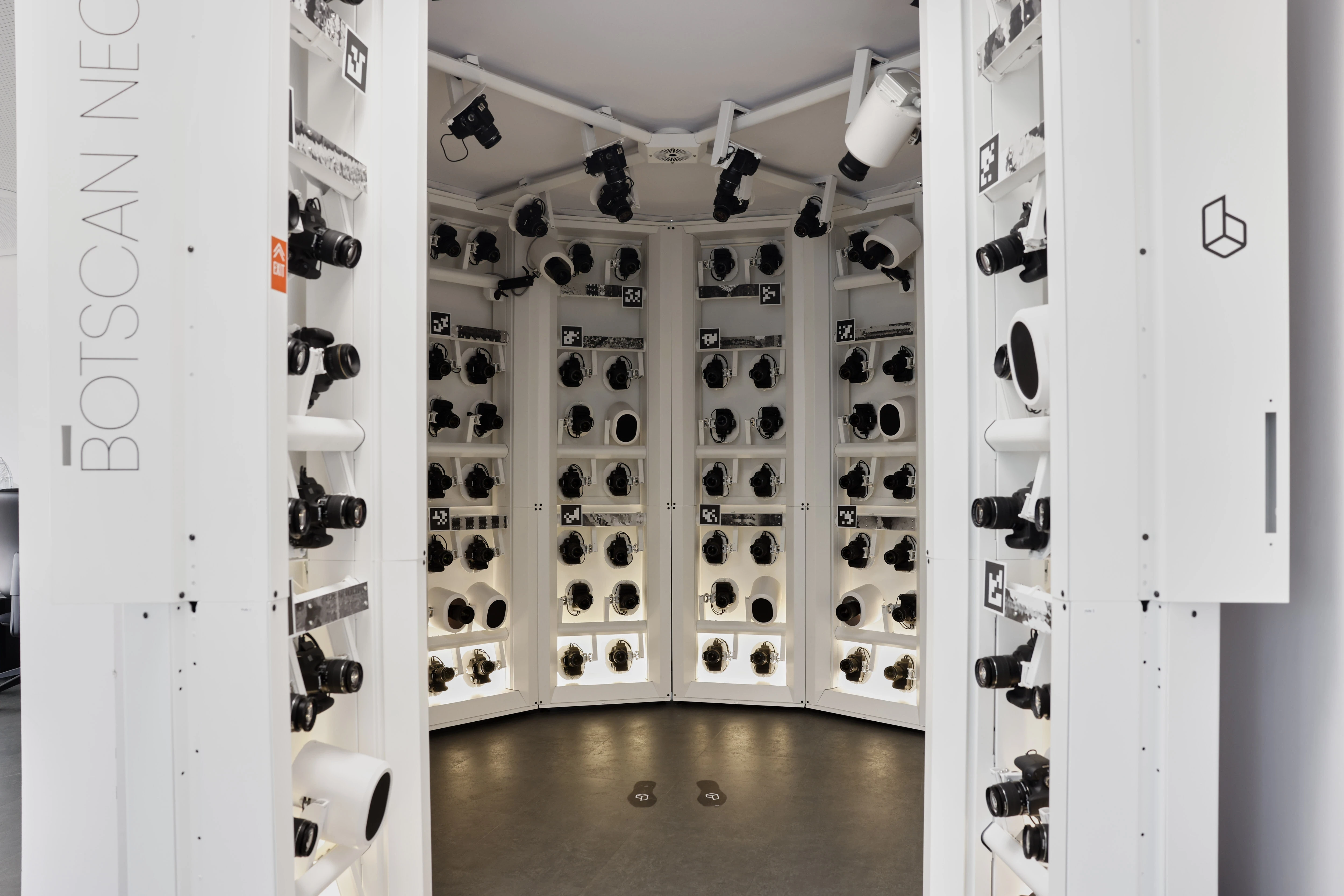
Simultaneous photogrammetric capture eliminates this problem at the point of acquisition. When cameras fire in a single synchronized instant, as they do in botspot's NEO Full-Body Scanner with its 160-camera array, the entire body is captured as one coherent moment with no interval during which motion can occur. As botspot's complete guide to photogrammetry rigs explains, even micro-movements such as breathing can introduce misalignments in sequential systems that are very difficult to correct in post-processing — a problem that simultaneous capture solves.
Color and Texture: The Data Laser Scanners Don't Capture
Laser scanners are geometry instruments. The return signal carries depth information, and from sufficient measurements the system constructs a surface. Appearance data — color, texture, material character — falls outside what the laser beam itself can record.
Some systems address this with an integrated RGB camera mounted alongside the laser unit. In practice, the color data captured this way is typically lower resolution than the geometric output, recorded at a different moment in the sweep, and prone to misregistration between texture and mesh. The result is a model in which the surface appearance and the surface geometry do not quite align — a limitation that becomes significant wherever photorealism matters.
For a substantial range of professional applications, appearance is not a secondary consideration. A digital double intended for film or game production must replicate not only the subject's proportions but the visual character of their skin, hair, and clothing. A cosmetic prosthetic requires accurate color reference to match the patient's skin tone. A heritage object needs its surface decoration, patina, and material detail recorded with the same fidelity as its geometry.
Photogrammetry captures both geometry and texture from the same cameras in the same instant. The texture is not appended after the fact — it is derived from the same images that produce the geometry, meaning the two are inherently and precisely registered to each other. With studio-grade flash systems and controlled color temperature, a professional photogrammetric scanning system produces photorealistic output across a wide range of skin tones, hair types, and fabric finishes without additional processing steps.
Challenging Surfaces: Where Each Technology Has Its Limits
Both technologies have known difficulties with certain surface types, but the surfaces that defeat them differ — and photogrammetry has a more complete set of solutions.
Laser scanners are physically compromised by surfaces that do not reflect the beam predictably. Dark materials absorb too much laser energy to return a reliable signal. Highly reflective surfaces scatter the beam at unpredictable angles. Translucent or semi-transparent materials, including certain fabric types and areas of thin tissue, allow the beam to penetrate rather than return from the surface. Hair, with its complex micro-geometry and variable reflectance properties, consistently produces fragmented or absent point cloud data on laser-based systems. These are not edge cases in body scanning — they describe a significant proportion of what a body scanner is routinely asked to capture.
Standard photogrammetry has its own vulnerability in surfaces that lack natural texture variation. Plain black clothing, monochrome fabrics, and low-contrast skin tones give the feature-matching algorithm insufficient data to work with, which can result in inaccurate geometry or reconstruction failure.
botspot's Digital Spray technology was developed to address this limitation directly. By projecting a high-contrast random noise pattern onto the surface during capture, the system provides the reconstruction algorithm with rich artificial feature data. Two sets of images are captured: one with the pattern projected, used for geometric reconstruction, and one without, used for the final texture output. The combination produces accurate geometry and true surface appearance even on materials that standard photogrammetry and laser scanning both struggle with. As botspot's case study of a plain black leather boot illustrates, the improvement in mesh quality on a dark, reflective surface is not marginal — it is the difference between a usable model and a failed scan.
Performance at Production Scale
Evaluating scanning technologies on the basis of a single controlled scan can be misleading. The more meaningful comparison is what happens at production scale: processing large numbers of subjects across multiple operators, over extended periods, with consistent output quality throughout.
Handheld laser scanning is inherently operator-dependent. The quality of the output reflects the experience and consistency of the person directing the device — their movement path around the subject, the distance they maintain from the surface, and the completeness of their coverage across difficult areas such as the underarms, the posterior, and the top of the head. Replicating that technique reliably across operators and sessions is a genuine and persistent challenge.
Automated photogrammetric systems remove operator variability from the process. Camera positions are fixed. Lighting is controlled and consistent. Calibration is verified before every session. Capture is initiated by a single trigger. The variables that cause laser scan quality to degrade at scale do not apply in the same way. A well-maintained photogrammetric scanning booth delivers the same output quality on the hundredth subject as on the first, regardless of which operator runs the session.
For workflows that require large-scale data collection — sizing surveys in fashion, population studies in ergonomics research, clinical monitoring programs, or high-volume production pipelines — this consistency is not incidental. It is what makes the data comparable across subjects and actionable at scale.
Processing Time and Pipeline Integration
The time cost of laser scanning extends well beyond the capture session itself. Merging multiple passes, filling geometric holes, reducing noise, correcting motion artifacts, and preparing the mesh for downstream use can represent a substantial post-processing burden for each subject. In high-volume environments, that burden compounds significantly.
Photogrammetric capture is near-instantaneous at the point of acquisition. An automated post-processing pipeline — such as the RealityScan workflow integrated into botspot's systems — delivers a finished, pipeline-ready mesh in minutes. Output in standard formats including OBJ, FBX, and PLY integrates directly with downstream professional tools: CAD environments for device fabrication, body measurement platforms such as 3D Measure Up, garment simulation software including CLO3D, and animation and rendering pipelines in film and games production. Clean input data means fewer correction steps downstream, and fewer correction steps mean faster, more reliable production workflows.
Where Laser Scanning Retains Its Strengths
An objective comparison requires acknowledging where laser-based technology genuinely excels. For large-scale architectural and civil engineering survey work, terrestrial LiDAR captures spatial data at ranges and with a flexibility of deployment that fixed-array photogrammetry cannot replicate. For precision industrial metrology on static mechanical components in controlled laboratory conditions, structured light scanning delivers sub-millimeter accuracy that remains a benchmark in its field. Where subjects are guaranteed to be static, color and texture are not required outputs, and the geometry falls outside the practical parameters of a fixed camera array, laser scanning remains a legitimate and well-supported choice.
The argument is not that laser scanning is the wrong tool in every context. It is that for human body scanning, the structural characteristics of sequential acquisition, limited texture output, and sensitivity to surface properties consistently produce results that fall short of what professional body scanning applications require.
Choosing the Right Method
The decision framework for professionals is, in practice, straightforward. Where the subject is static, appearance data is not needed, and the capture environment does not suit a fixed camera array, laser scanning merits serious consideration. Where the subject is a human body and the output must be measured, fabricated against, rendered, or used as the basis for a professional decision, the evidence and the workflows both point consistently toward photogrammetry.
The combination of simultaneous capture, photorealistic texture output, Digital Spray capability for challenging surfaces, and automated processing pipelines means that professional photogrammetric systems deliver what body scanning demands: accurate, complete, and repeatable data, captured in an instant and ready for immediate use.


Industries Where Millimeters Matter: Why These Sectors Rely on High-Accuracy 3D Body Scanning
5 Things Cheap 3D Body Scanners Can't Do (That Professional Ones Can)
Augmented Ubiquity: The First 4D Gaussian Splat Captured with a botspot Scanner

360° Photography with the Momentum 2.0
botspot’s Automation Suite: Complete Control Over Your 3D Scanning Workflow